
Understanding Hunt County Releases
A Hunt County jail release means one booking episode has ended. It does not always mean the person walked into the community with no case or custody left. Bond can end detention while charges and court rules remain active. Time served can end the local jail term, yet another warrant or hold may apply. A transfer to the Texas Department of Criminal Justice, the United States Marshals Service, or immigration custody also ends the Hunt booking without ending confinement.
The official jail archive is unusually useful. A date-range search can preserve a row with a Released Date after the person has vanished from the current roster. Opening that released row may then state that the selected party is not currently in jail while hiding the richer booking detail. Treat this as proof that Hunt marked that jail episode closed. Use a signed court record or the receiving agency's file to learn the legal reason and next destination.
- Release
- The end of a specific custody episode.
- Discharge
- Completion of the sentence and any state supervision.
- Time served
- Credit that satisfies the confinement ordered in the judgment.
- Detainer
- A request from another agency concerning custody or release notice.
Hunt County Release Paths
The word “released” covers several outcomes. The Hunt archive supplies a date, but its public result does not publish a release reason, exact time, authority, or destination. That gap makes the next record important. Match the Hunt Released Date to the source that governs the claimed path.
| Path | What it means | Best next record |
|---|---|---|
| Surety or personal bond | Jail custody ends while the criminal case continues. | Signed bond and conditions from the court clerk |
| Time served | Credited time meets the confinement part of a judgment. | Judgment, jail-credit entry, and release log |
| Dismissal or court order | One legal basis for detention may end. | Signed dismissal or release order |
| TDCJ transfer | County custody ends and state prison custody starts. | TDCJ offender detail and incarceration history |
| Federal or ICE pickup | Another sovereign may assume custody. | BOP, federal court, ICE, or agency record |
Death and escape can also close a custody entry in data terms, but neither is a community release. Use “booking episode ended” until the reason is verified. A court order signed before jail processing also does not establish the moment of physical exit.
Hunt County Release Record Fields
The Hunt County jail search has a live mode and a historical mode. Blank date fields call up current inmates. Entered dates ask who was in custody at some point during that span. The historical result table is not a release-only list, but it can show an actual Released Date for a matched booking.
| Public field | What it establishes |
|---|---|
| Name | The displayed identity, which still needs a second identifier |
| Gender and race | Match aids, not unique proof |
| Booking Date | The start marker for the displayed jail episode |
| Released Date | The date Hunt marked that episode ended |
| Jailing ID | The key to cite in a focused records request |
The public table does not show the release type, exact time, destination, receiving agency, or booking photograph. Ask for those existing fields if they are maintained and public. A blank field is not permission to infer an answer from a nearby docket event or a commercial page.
Request Hunt County Release Records
Use the Sheriff's Criminal Investigations and open-records route for a jail release entry, booking sheet, release log, and booking photograph. Texas requests should identify existing records instead of asking staff to research a narrative. Hunt accepts sheriff open-record requests in person or by fax during published weekday hours.
- Give the full name, aliases, date of birth if known, booking date, Released Date range, and jailing ID.
- List each record sought, including the booking sheet, actual release date and time, recorded release reason or destination, authority or order, and booking photo.
- Ask for electronic copies and a cost estimate before charges exceed an amount you choose.
- If an active-case exception is raised, ask whether segregable basic information can still be released.
- Keep the response and compare it with the signed court or receiving-agency record.
2801 Stuart Street
Greenville, TX 75401
Phone: 903-453-6800
Open-record fax: 903-461-7793
Requests: Monday through Friday, 8 a.m. to 4 p.m.
Texas Government Code Chapter 552 requires prompt production, but the ten-business-day rule often quoted from Section 552.301 concerns seeking an Attorney General decision to withhold. It is not a guaranteed delivery date. Volume, review, clarification, and lawful exceptions affect timing. Hunt has not published the archive's retention period or a standard sheriff fee for these items.
Courts Explain Hunt County Releases
Custody and court files answer different questions. The Released Date shows when Hunt closed the booking. A signed judgment, bond order, dismissal, writ, or discharge order may explain why. Felony records route through the Hunt County District Clerk. Misdemeanor records route through the County Clerk and County Courts at Law. Judicial records use the clerk and court access process, not an ordinary Public Information Act request.
The online Tyler portal can supply an index, case number, court, charge, docket event, or disposition label. It may not display the signed image. Certified proof comes from the clerk. County Clerk inspection is free and ordinary copies are listed at one dollar per page. District fees differ, so check the current official schedule before ordering.
Expunction under Texas Code of Criminal Procedure Chapter 55A is case-specific. Nondisclosure under Government Code Chapter 411 restricts public disclosure but is not the same as destruction. A release date alone creates neither remedy. A lawful order can also explain why an old row or case is no longer public.
Bonded Hunt County Releases
Hunt County has a Bail Bond Board and an official licensed-company list. No fixed countywide bond schedule was verified. Amounts and terms belong to the individual magistration or court record. A Hunt bond-condition order can require immediate reporting to HCCSCD Pretrial Supervision, so leaving jail may begin a new set of court duties rather than end the case.
For a bond release, pair three records: the actual Released Date, the signed bond or condition order, and the person's own HCCSCD instructions. Texas delay statutes and Hunt forms apply only in defined circumstances. They are not a general countdown for everyone held at the detention center.
Find Released Hunt County Inmates
A current roster answers who is held now. It naturally drops a person after Hunt closes the booking. The historical archive is therefore the first strong local check for someone known to have passed through this jail. Search dates that overlap custody, not just the suspected release day, because the form tests custody overlap rather than filtering by release date.
- Search the official Hunt archive with a practical date range.
- Match full displayed name, booking date, and jailing ID. Then read Released Date.
- Open the row. A notice that the party is not currently in jail supports departure, even though detail is suppressed.
- Check the signed Hunt court record for the reason and conditions.
- If transfer is possible, search TDCJ, BOP, or ICE records. Request the jail file when the public sources do not settle the question.
The archive has no dedicated rolling recent-release feed. The Hunt County 24-hour release list method explains how to compare a one-day custody range, while this named-person path follows one identity across systems.
TDCJ Hunt County Release Search
Use the TDCJ offender search when a Hunt felony case may have led to state prison or when the county release may be a state transfer. Gather the legal name, aliases, date of birth, TDCJ or SID number if known, and county of conviction. A number match is safer than name alone.
| Field or label | How to read it |
|---|---|
| TDCJ or SID number | Strong identifier for the state record |
| Current location/status | Shows the state custody or supervision context |
| Projected Release Date | A Classification and Records projection, not a promise |
| Scheduled date/location | Later operational data that may change |
| Parole Review Information | Board process or vote information, not physical release |
The TDCJ definitions distinguish a releasee on parole or mandatory supervision from a person fully discharged. If the public search does not answer the question, Classification and Records can address actual time, transfer, and release at 936-437-6231. TDCJ also offers a no-cost offender-information email route, but that channel does not provide photos.
The official TDCJ search screen shows why identity fields must be matched before dates are read.
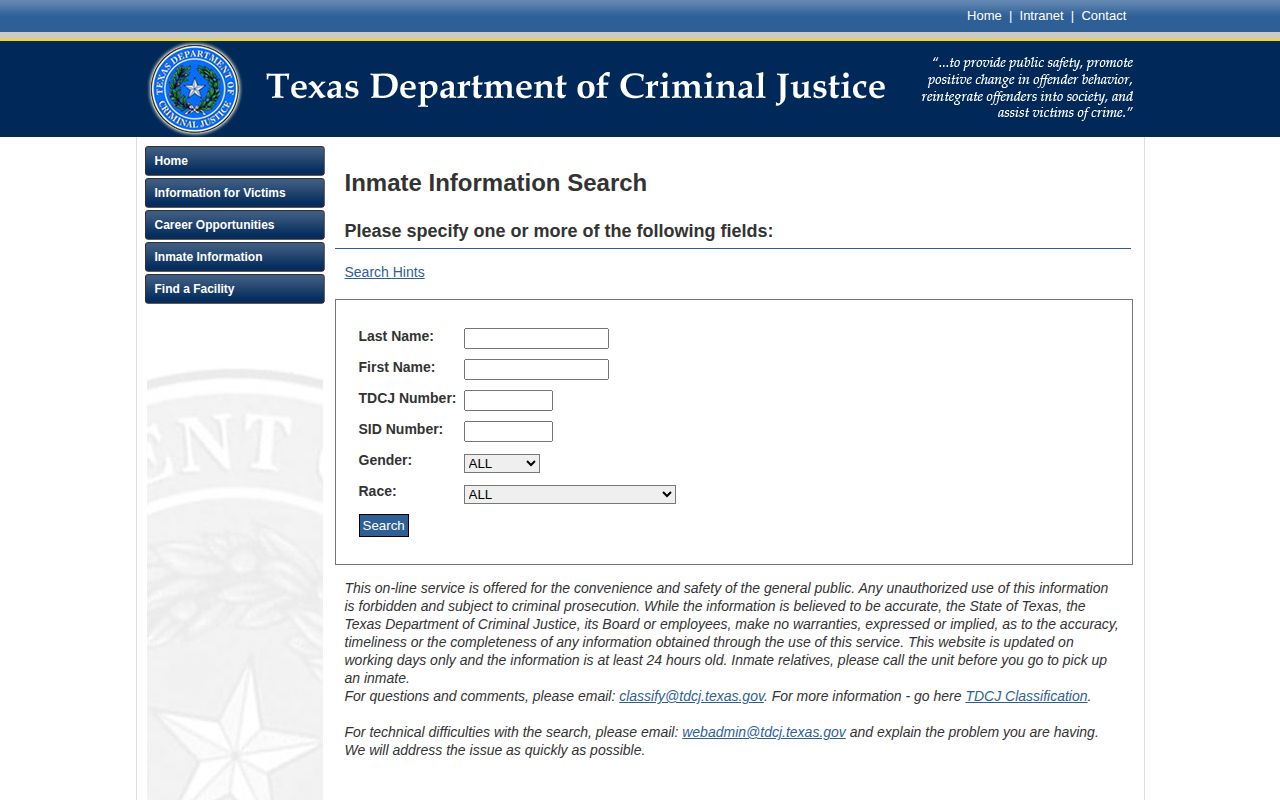
A projected or scheduled value in that system concerns state custody. It does not replace Hunt's actual Released Date for the earlier county booking.
Hunt County Release Alerts
Texas replaced the old county VINELink brand with Texas IVSS-Counties on September 1, 2025. Search the participating-county portal for a specific offender or case. Registration can add phone, text, or email alerts for custody and court changes. Current accounts use password and contact verification, not the old telephone PIN instructions found on legacy flyers.
An alert is a lead, not the final record. A transfer-to-TDCJ alert is a custody change rather than community release. Confirm a Hunt release notice against the archive's Released Date and the court or receiving-system record. State prisoners and parolees use the separate TDCJ IVSS service.
Hunt County Post-Release Records
Probation is court-ordered community supervision, usually in place of or after a local sentence. Hunt County Community Supervision and Corrections Department handles probation and pretrial supervision at 4515 Stonewall Street in Greenville. Its client tools are not a public person locator. Parole and mandatory supervision follow a TDCJ prison case and route through the Greenville District Parole Office at 6130 Highway 66.
Check the TDCJ offender detail and Parole Review Information, then use the proper office for the released person's own compliance questions. A favorable Board vote can still depend on date calculation, program work, an approved residence, detainers, and processing. Hunt County parole and probation records preserve the two-office split and its distinct warrant limits.
Property After Hunt County Release
The Sheriff's page says property or evidence pickup requires an appointment at 903-453-6849. That statement concerns the evidence contact. Hunt County has not published it as the Detention Center's rule for returning an inmate's personal belongings at discharge. Keep the two processes separate and call the jail for the booking-specific procedure.
The TDCJ Reentry Program may help eligible state prisoners seek replacement identity documents before release, including a Social Security card, birth certificate, or state ID. It does not apply to every county-jail release and is not a Hunt jail program.
Travel After Hunt County Release
The Connection is a countywide, reservation-based public transit service. It is not a jail release program. Its weekday and advance-reservation model may help when pickup can be planned, but it does not solve an unexpected night or weekend release. Confirm service and fare with the operator at 903-454-1444.
No official source gives a fixed Hunt release time, exit door, family waiting area, holiday procedure, or ride arrangement. Visitation hours and sheriff business hours do not establish when discharge processing occurs.
Federal Hunt County Release Checks
The BOP inmate locator generally covers federal custody from 1982 forward. Match a register number in the five-digit, hyphen, three-digit format when possible, or use exact biographical fields. Read Release Date with Location. “IN TRANSIT” means movement, and a community corrections placement can remain BOP-related custody.
An ICE detainer asks for release notice and up to 48 extra hours beyond ordinary authority so ICE may assume custody. It does not prove pickup occurred. If pickup happens, Hunt custody ends while immigration custody begins. The ICE detainee locator may include adults currently detained or released from ICE custody within the prior 60 days, subject to exclusions and lag. A missing result proves little. Use the Detention Reporting and Information Line when the locator is inconclusive.
Hunt County Release-Area Study
Hunt County studied converting its 1984 jail, now associated with the Juvenile Center, into a centralized processing site with a named release area, sally port, testing, records, and transfer functions. The county architectural study is real local facility history. Completion was not verified, so it cannot establish today's exit point or release process.
Compare Hunt County Custody Records
Choose a system by custody scope. One locator cannot answer every release question.
| System | Best use | Key limit |
|---|---|---|
| Hunt live roster | Who is held now | Released people usually disappear |
| Hunt historical archive | Booking and Released Date | Not a release-only filter |
| Hunt court file | Legal reason, order, and conditions | Order time may differ from exit time |
| TDCJ | State prison, parole, or discharge | Not for county-only detention |
| BOP or ICE | Federal or immigration custody | Each has narrow coverage |
Hunt County Detention Center Releases
The Hunt County Detention Center is the one adult detention facility in the research Facility Map. It is operated by the Sheriff at 2801 Stuart Street in Greenville. Its rated capacity is 389, but that procurement figure is not current occupancy or annual release volume. No official annual booking or release count was found.
A release from this jail can lead to the community, court supervision, TDCJ, another jurisdiction, federal custody, or immigration custody. Confirm the jail end date first. Then follow the record for the next system.