
Record Hunt Date Meanings
Write down the source, access date, and exact label for every date found. A judgment date marks court action. A parole eligibility date marks when review may become possible. Projected Release Date is a calculation. Scheduled Release is later planning data. Released Date marks the end of a Hunt jail episode. Discharge Date can mark completion of the sentence and attached supervision. Keeping those meanings separate prevents a future estimate from being reported as a completed release.
Also record the location or custody status displayed beside the date. A person can leave Hunt County for TDCJ, a federal custodian, or another hold. That movement ends one episode but does not establish freedom in the community. The receiving agency's admission or status record supplies the next part of the timeline.
Choose the Hunt Date Source
A projected-date search begins by naming the custody system. Hunt County Detention Center records describe a county booking. TDCJ records describe state-prison confinement and conditional-release review. BOP records describe sentenced federal custody. These systems do not share one release clock, and a person can move from one to another on the same day.
Use the Hunt Jailing ID and booking dates for a county episode. Use a SID or TDCJ number for state custody. A signed judgment identifies the sentence, jail credit, offense findings, and whether terms run together or one after another. The jail row establishes when the local episode ended, but it may not say why or where the person went.
When an official date is absent, request the existing calculation or incarceration history from the responsible custodian. TDCJ's no-cost offender-information channel can provide incarceration history and Projected Release Date with strong identifiers, though it does not provide photographs. Classification and Records handles more focused calculation questions. A Hunt-only sentence question belongs with the local custodian and the court record. Asking the right office prevents a county date from being mistaken for a state discharge.
Hunt Projected and Actual Dates
TDCJ defines Projected Release Date as a Classification and Records projection based on the applicable offense and sentence rules if parole does not occur sooner. Scheduled Release date and location are later operational fields. TDCJ warns that even scheduled information can change without notice. Neither field proves the person crossed out of custody.
An actual release date records a completed custody event. Hunt's jail archive displays Released Date for a county booking, although a released row may suppress the detailed booking view. A TDCJ incarceration history or release entry addresses state custody. Court records explain the authority, such as bond, time served, dismissal, or sentence completion. Use the record closest to each fact.
Find Hunt Projected Release Dates
For a sentenced state prisoner, use the TDCJ Offender Search. A TDCJ or SID number gives the cleanest match. Name searches require careful comparison of birth date, offense, county of conviction, and current location. The detail may show projected release, scheduled release information, and parole review data. Preserve each official label rather than shortening every field to “release date.”
- Identify whether Hunt County, TDCJ, federal authorities, or another agency has custody.
- Gather the full legal name, aliases, birth date, case number, and TDCJ or SID number if known.
- Open the official record and match several identifiers.
- Read the projection beside offense, location, and parole-review fields.
- Ask TDCJ Classification and Records to clarify a calculation or actual state release.
- Return after the date and verify the actual status or release record.
If the person only had a Hunt jail case, the state search may have no record. Use the Hunt County release search, the court judgment, and the jail records route. A transfer from Hunt to TDCJ ends the county booking but starts state custody.
Texas Good Time Rules
Texas Government Code Section 498.003 makes good-conduct time classification-based and calls it a privilege, not a right. Section 498.004 addresses forfeiture and possible restoration. Section 498.005 supplies the key limit: credit can affect parole or mandatory-supervision eligibility when the law permits, but it does not reduce the sentence imposed by the court.
Mandatory supervision is a statutory form of conditional release, distinct from discretionary parole. For eligible older cases, flat time plus good time reaching the sentence can create a scheduled mandatory-supervision date. For covered cases after August 31, 1996, the arithmetic and BPP approval are required. Government Code Sections 508.147 and 508.149 govern the mechanism, exclusions, and discretionary review. If the Board denies mandatory supervision, the projection may move to maximum expiration. A later approval can move it again.
Good time is not a universal subtraction tool. Offense date selects the controlling law. Disciplinary changes can alter credits, and some offenses are excluded from mandatory supervision. A public calculator cannot safely combine all those facts. Classification and Records maintains the official computation.
Hunt Release Date Changes
A date may change without any error in the public record. Each field reflects the facts and legal rules known when it was calculated. The most useful response is to identify the factor, keep the earlier label, and request clarification instead of treating one screen capture as permanent.
| Factor | Possible effect |
|---|---|
| Good-time forfeiture or restoration | Changes an allowed eligibility calculation without changing the court sentence. |
| Parole or mandatory-supervision vote | May create, condition, deny, or defer a release pathway. |
| Program requirement | A favorable vote may still wait for transfer and completion. |
| New judgment or consecutive sentence | Adds legal time or changes how terms operate together. |
| Detainer or hold | Can move the person to another custodian instead of the community. |
| Residence-plan review | Can delay a conditional-release plan. |
| Calculation audit | Can correct the scheduled or projected date. |
No Texas 85 Percent Rule
Texas should not be described as having a general rule that every prisoner serves 85 percent. Ordinary parole eligibility under Government Code Section 508.145(f) generally uses calendar time plus good-conduct time reaching one-fourth of the sentence or 15 years, whichever is less. That is an eligibility threshold, not a promise of parole.
For aggravated or deadly-weapon cases tied to Code of Criminal Procedure Article 42A.054, Section 508.145(d) generally requires actual calendar time equal to one-half of the sentence or 30 years, whichever is less, with a two-year minimum. Good time does not count toward that threshold. Offense date, enhancements, consecutive terms, and other subsections can change the analysis. The old phrase “3g offense” is legacy shorthand; the current reference is Article 42A.054.
Reaching eligibility only permits Board consideration. It does not mean the Board voted favorably, that a program is complete, or that release occurred. The Hunt parole and probation resource explains the file-based vote process and local supervision offices.
Hunt County Jail Calculations
A person awaiting trial usually has no fixed projected release date. The next custody event may depend on magistration, bond, a court hearing, dismissal, a hold, or transfer. For a sentenced county-jail term, the signed judgment, jail credit, and custodian's calculation control. TDCJ good-time rules should not be imported into a Hunt-only jail sentence.
Hunt has a local personal-bond form that applies Code of Criminal Procedure Article 17.151 delay rules in certain misdemeanor cases when the State is not ready. The form refers to different time thresholds for eligible Class B and Class A matters. Those safeguards have legal conditions. They are not a countywide clock promising when every detainee will leave.
Start with the Hunt archive's Released Date when checking a completed booking. Then obtain the bond order, judgment, or dismissal from the proper clerk to learn the legal reason. A jail release may also be a transfer to TDCJ, USMS, or ICE. “Booking ended” is safer than “went home” until the destination is verified.
TDCJ Projection Field Example
The official TDCJ search can display the date field for a lawfully accessible offender record.
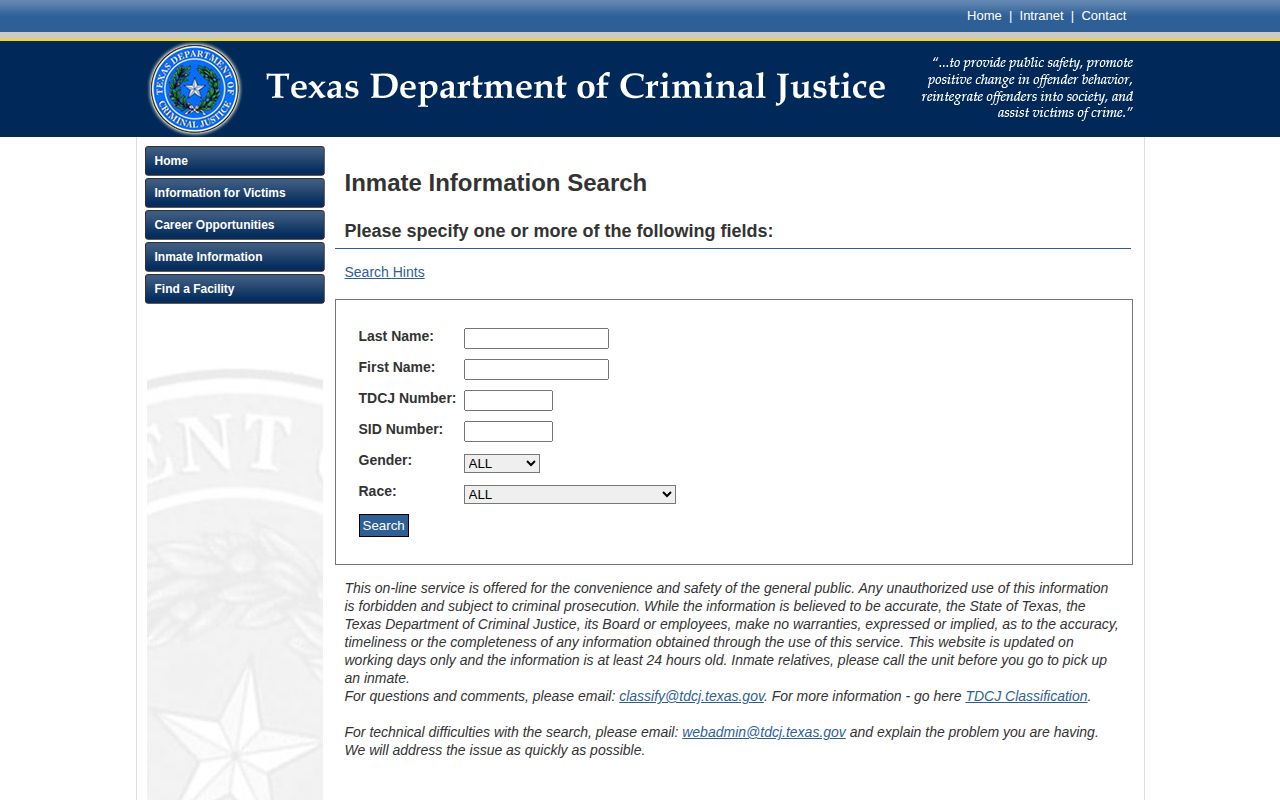
The field is useful because it comes from the state custodian, but it remains a projection. Record the access date and compare it with scheduled information, parole review data, and later actual status. For an unclear calculation, contact Classification and Records at 936-437-6231 or use the agency's records process.
Confirm Hunt County Release
A pending alert can help, but it is secondary evidence. County jail and court events belong in Texas IVSS-Counties. State-prison and parole events use separate TDCJ IVSS. The VINELink inmate check page explains the current Texas IVSS transition and registration channels.
After the expected date, compare the correct official sources. Use Hunt Released Date for the county episode, TDCJ status for state custody, and the signed court record for legal disposition. If the records differ, preserve all dates with their exact meanings and ask the responsible custodian to reconcile them. Never choose the date that best fits an assumption.
Public Record Search
Sponsored Results