
Choose the Hunt Alert Channel
The correct alert channel follows the person, not the county where the case began. A Hunt jail or county-court event belongs in Texas IVSS-Counties. A later state-prison admission, parole review, or mandatory-supervision event belongs in TDCJ IVSS. Keeping both records can be necessary when a county release is actually a transfer into state custody.
Federal custody is outside both Texas services. The Bureau of Prisons locator covers sentenced federal prisoners, while a USMS pretrial detainee may not appear as a sentenced BOP prisoner. ICE uses its own locator and assistance line. A missing record in Texas IVSS should therefore lead to a custodian check, not an assumption that the person is free.
Older saved links can add confusion. Texas's county notification system changed after the migration, but search engines and printed flyers may still use VINELink, VINE, or the old telephone number. Use those names only to recognize the former service. New searches and account changes should start at the current IVSS portal. If a migrated record or login fails, the statewide county-system help line can troubleshoot the account while Hunt's archive remains the direct source for the county Released Date.
Hunt VINELink Is Now IVSS
Texas moved county victim-notification services from VINE and VINELink to Texas IVSS-Counties on September 1, 2025. Current instructions should use the new portal and account process. Existing registrations were migrated, but a first login may require a password update. Phone and text messages may also come from a different provider than older alerts.
The portal can be searched without registration for available participating-county offender and case data. An account adds notification management. The Attorney General describes events such as booking, release, court changes, escape, death, and transfer to TDCJ. Not every event means community release. In particular, a transfer alert means custody changed from one agency to another.
Search Hunt County IVSS
Search for one specific person or case. Gather the full legal name, aliases, birth date, Hunt jailing ID, and case number when available. A strong identifier reduces false matches. The portal's exact labels may change, so follow the current controls and preserve the wording displayed in the selected result.
- Open Texas IVSS-Counties and select or confirm the county context shown by the portal.
- Enter the available name, offender, or case identifiers for the specific record.
- Compare all visible identity details before selecting a result.
- Read the custody and court-event labels as written.
- Note whether the result concerns Hunt jail custody, a court event, or transfer to TDCJ.
- Verify a reported release against Hunt Released Date and the relevant court disposition.
If the county portal does not return the expected record, call Texas IVSS-Counties support at 866-268-8959, available around the clock, and use the direct Hunt archive. A missing result or missing alert cannot prove that no release occurred.
Hunt IVSS Release Fields
Texas IVSS is an event-notification system, not a complete release certificate. Available fields depend on the source record and current portal design. Read an alert as a prompt to check the agency record that created the event.
| Information | How to interpret it |
|---|---|
| Identity or case details | Use several identifiers to avoid choosing a similar name. |
| Custody status | Shows the reported state of the county record, subject to update timing. |
| Booking or release event | Signals a change that should be checked against Hunt's archive or requested record. |
| Court event | Points to case activity, not necessarily physical release. |
| Transfer to TDCJ | Ends or changes county custody but begins state custody. |
| Notification history | Shows account alert activity, not every official record event. |
Hunt's official jail archive is unusually helpful because it accepts historical custody dates and displays Released Date. Yet opening a released row may suppress the detailed view. Pair that date with the signed court order or a targeted Sheriff's records request when the reason, time, or destination matters.
Register Hunt Release Alerts
Registration lets an account follow a selected offender or case. Use contact information controlled by the registrant, and review the portal's current privacy and notification terms. Exact button names can change. The supported process is based on account association and verified channels.
- Search and select the correct offender or case record.
- Create an account or sign in to an existing migrated account.
- Associate the selected record with the account.
- Choose text, telephone call, email, or the channels currently offered.
- Set preferences such as preferred contact periods or blackout dates.
- Verify the account and contact details through the current prompt.
- Return to manage, pause, or review alert history as needed.
Do not enter a legacy telephone PIN unless the current official portal itself explicitly presents that requirement. Old Texas flyers and cached pages can still describe the former VINE system. Current county alerts use Texas IVSS-Counties.
County and TDCJ Alert Split
Texas operates two distinct notification layers. Texas IVSS-Counties covers participating county jail and court events. TDCJ IVSS covers state-prison custody plus parole or mandatory supervision and supports confidential registration. A person transferred out of Hunt County may need to be followed through TDCJ rather than the county portal.
This custody distinction prevents a common error. A Hunt Released Date can mean the county booking ended because TDCJ assumed custody. Likewise, a county transfer alert is not proof that the person entered the community. Search TDCJ by SID or TDCJ number when known, compare the offender detail, and use Classification and Records for actual state-release questions.
A person held only in the Hunt County Detention Center may never appear in the TDCJ offender search. Conversely, a state prisoner may no longer have useful current data in the county system. Start with the custodian, not the most familiar brand name.
Hunt IVSS Screen Example
The current Texas IVSS-Counties portal is the official starting point for county alerts.
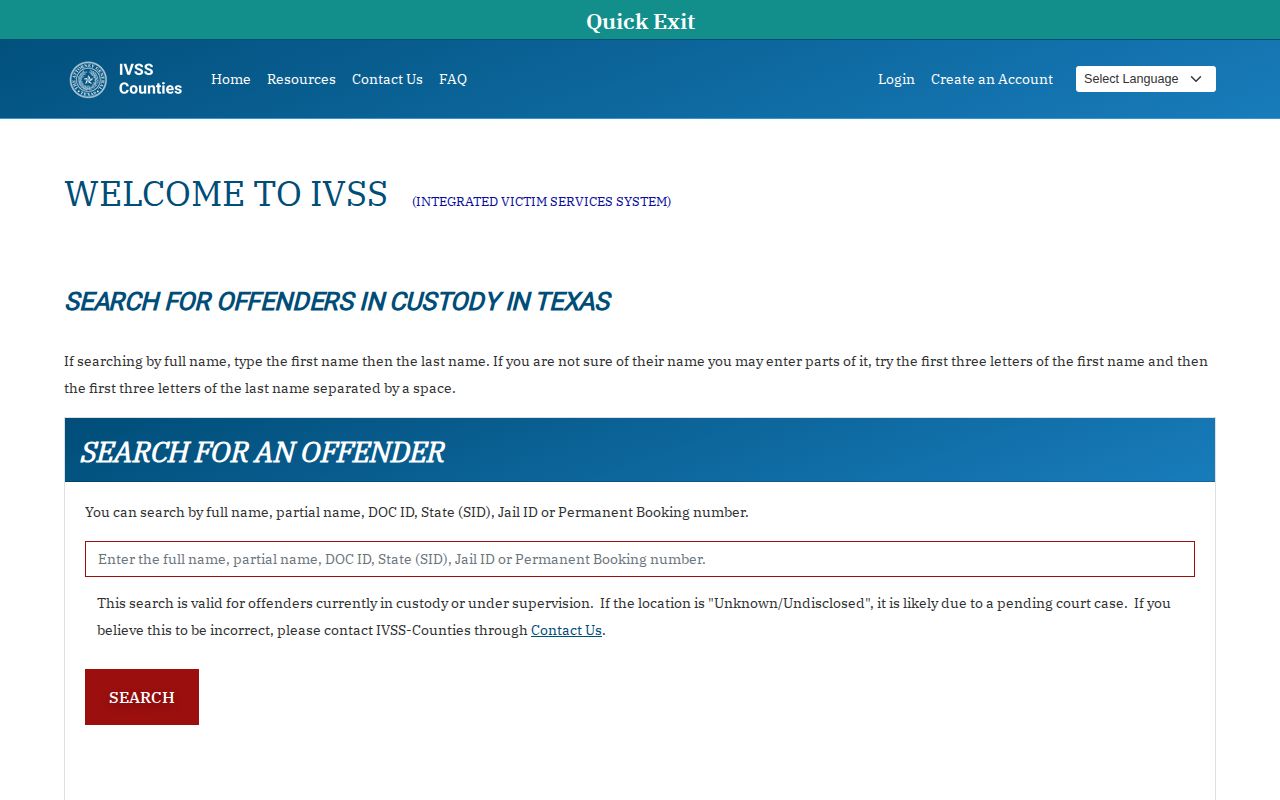
The screenshot documents the current Texas brand and search channel without exposing private registration data. Portal labels may change after capture, so use the live interface for each search and account change.
Hunt Release Alert Limits
An alert is secondary notice. Service interruption, incorrect contact data, county participation limits, account migration issues, and update delays can all cause silence. No alert does not mean no booking, transfer, or release. A text also cannot establish the legal reason for release.
Texas IVSS does not replace federal systems. A sentenced federal prisoner is checked through the Bureau of Prisons locator. A USMS pretrial detainee may not appear as a sentenced BOP prisoner. ICE's locator has its own limits and covers current detention plus some recent releases. None of those systems should be treated as part of Hunt County IVSS.
- Confirm county departure through Hunt Released Date or a Sheriff's release record.
- Confirm case disposition through the signed Hunt court record.
- Confirm state custody or discharge through TDCJ.
- Confirm federal custody through the responsible federal source.
- Treat a transfer as continued custody until the receiving status is known.
Confirm Hunt County Release
Begin with the event reported by IVSS. If it says release, search a date range overlapping custody in Hunt's official archive and compare Released Date. The result list covers people in custody during the chosen span, not a release-only feed. Match name, booking date, and Jailing ID. Then obtain the court order or requested release record when the reason or destination is needed.
For state custody, compare the TDCJ offender detail's current location, projected or scheduled fields, parole review information, and later status. A future date is not release. For help with that distinction, see the Hunt County projected release date resource. The Hunt County released-inmate search connects county, court, state, federal, and records-request channels.
If official dates disagree, keep each date with its label and source. A judgment date, scheduled date, alert time, and physical Released Date can all differ for valid reasons. Ask the office responsible for the disputed field rather than merging them into one date.
Public Record Search
Sponsored Results