
Hunt County Three-Day Release Check
The official Hunt County jail archive is the starting point, but its form must be interpreted on its own terms. There is no 72-hour button, recent-release tab, or separate release endpoint. A blank submission displays current inmates. A dated submission reports people “in custody during that time.” For a three-day check, the reader supplies the dates and then performs the release-date comparison.
This method works well when a family knows an approximate weekend or several-day period. It is not a count of releases. Someone booked well before the window can appear because custody continued into it. Another person may have a Released Date after the selected range because the query asks about overlap. Only a Released Date within the target 72 hours belongs in the desired set.
Search Hunt County 72-Hour Releases
Define the three calendar dates before opening the form. That matters around midnight and when “the last three days” is being used loosely. The form posts its state to a results endpoint, so saving that bare endpoint does not reproduce the chosen dates. Keep a simple note of the range and access date.
- Enter a Starting Date and Ending Date that cover the suspected three-day custody period.
- Set a result limit suitable for the query. The displayed maximum is 500, but the total is custody overlap, not total releases.
- Submit and match the full name, Booking Date, and available Jailing ID rather than relying on name alone.
- Compare Released Date to the exact 72-hour period. Exclude blank values and dates outside it.
- Open a released row and preserve the county response that the selected party is not currently in jail.
- Check the court record or receiving system when the reason or destination is important.
For a tighter current-day check, use the Hunt County 24-Hour Release List method. The three-day process is designed for broader catch-up, not rapid monitoring of one known event.
Hunt County 72-Hour Record Fields
The same county result table serves all dated ranges. It has enough data to identify a county-jail episode and test whether it ended, yet it omits the facts needed to explain that ending. Its actual fields are narrower than a typical release log.
| Field | Use in a 72-hour check |
|---|---|
| Name | Finds a possible person; compare identifiers before deciding it is the right booking. |
| Gender and Race | Helps separate similar names, subject to the limits of the source data. |
| Booking Date | Anchors the beginning of the listed Hunt County custody episode. |
| Released Date | Shows when Hunt County marked that episode ended. Compare it to the chosen three days. |
| Jailing ID | Supports a precise follow-up request for the release sheet or booking record. |
No public column gives release time, bond or other reason, destination, receiving agency, releasing order, charge detail in the released state, or booking photograph. A row is therefore strong for the date Hunt custody ended and weak for explaining what happened next.
Hunt County Weekend Release Window
A three-day search is practical around weekends because it reduces the risk of choosing the wrong single calendar date. It can also cover a holiday-adjacent span. Still, Hunt County publishes no official weekend or holiday release schedule, fixed processing hour, exit door, or update cadence. The wider window is a search choice, not evidence that processing follows a three-day cycle.
A signed bond order or judgment may predate physical exit because jail staff must complete administrative steps and check other holds. Conversely, a web row may update after the person left. Compare the county Released Date with the signed court document instead of treating either timestamp as interchangeable. For urgent status, call the Detention Center at 903-453-6851.
Transfers also complicate weekend review. A person can leave Hunt County custody and enter TDCJ, another jail, federal custody, or ICE custody. A filled Released Date does not establish arrival in the community. The correct destination system supplies the next fact.
Hunt County Released-Row Detail Gap
The archive’s distinctive feature is also its main limit. Arbitrary custody ranges and Released Date remain searchable, but opening a released row can hide the richer booking detail and state only that the party is not currently in jail. It is not a rolling 72-hour feed and does not filter by release date.
This creates a two-record method. Preserve the archive row for the actual county end date. Then use the Hunt court portal and proper clerk, or request the jail record, to find the authority and outcome. Felony files route through the District Clerk. Misdemeanor files route through the County Clerk and County Courts at Law. Judicial records use court access procedures rather than an ordinary Public Information Act request.
If the dates conflict, keep both labels and meanings. A judgment date, scheduled release date, and actual Released Date can all be valid while describing separate stages. Do not choose the one that best fits an assumption.
Hunt County Release Status Paths
A current-roster row and a historical released row answer opposite custody questions. State and federal systems then cover different populations. Separating them prevents a county transfer from being reported as freedom from all custody.
| Question | Best source | Limit |
|---|---|---|
| Still in Hunt jail? | Blank official jail search or jail call | A released person usually drops from the live view. |
| Did the Hunt booking end? | Dated archive and Released Date | Reason and destination are absent. |
| Transferred to state prison? | TDCJ offender search and records | It does not cover county-only releases. |
| Federal or immigration custody? | BOP locator or ICE ODLS | Each has a limited population and timeframe. |
Texas IVSS-Counties may supply alerts for available county jail or court records. Texas now uses this system instead of the old county VINELink platform. TDCJ IVSS is a different portal for prison and parole events. Notifications should prompt an official record check; silence is not proof that no release occurred.
Confirm Hunt County Three-Day Releases
When the archive lacks the needed detail, use the Hunt County sheriff records route. Identify the full name and aliases, date of birth if known, Jailing ID, Booking Date, and the three-day release range. Ask for existing records instead of asking the agency to research a story.
A focused request can list the booking sheet, release log entry with actual date and time, release reason or type, destination or receiving agency if recorded and public, authority or order, and booking photograph. Request electronic delivery and a cost estimate. Hunt County publishes no specific release-record fee, photo fee, retention span, or guaranteed production time.
Section 552.221 of the Texas Public Information Act requires prompt production. The ten-business-day rule in Section 552.301 generally concerns asking the Attorney General for a withholding decision, not guaranteed completion. Active law-enforcement material and other protected information may be withheld or redacted.
For transfers, use the agency that could have received the person. TDCJ is the state-prison system. BOP covers federal imprisonment. ICE ODLS can include current and recently released immigration detainees within its stated limits. A Hunt sheriff request cannot compel those separate systems to produce their records.
County and court records should be paired by episode. A jail Released Date answers when Hunt County closed that booking. A signed bond order, dismissal, judgment, revocation document, or transfer writ can explain the legal event. A closed portal label alone does not prove the physical exit date, and a pending case does not mean the person remained jailed through the full three-day span.
If the sheriff response omits a destination or release reason, record that fact as not maintained, not located, withheld, or not supplied, according to the actual response. Do not fill the gap with a nearby court date. Exact labels preserve the difference between evidence and inference.
The county archive form visually confirms the date-range and result-limit inputs used for the three-day method.
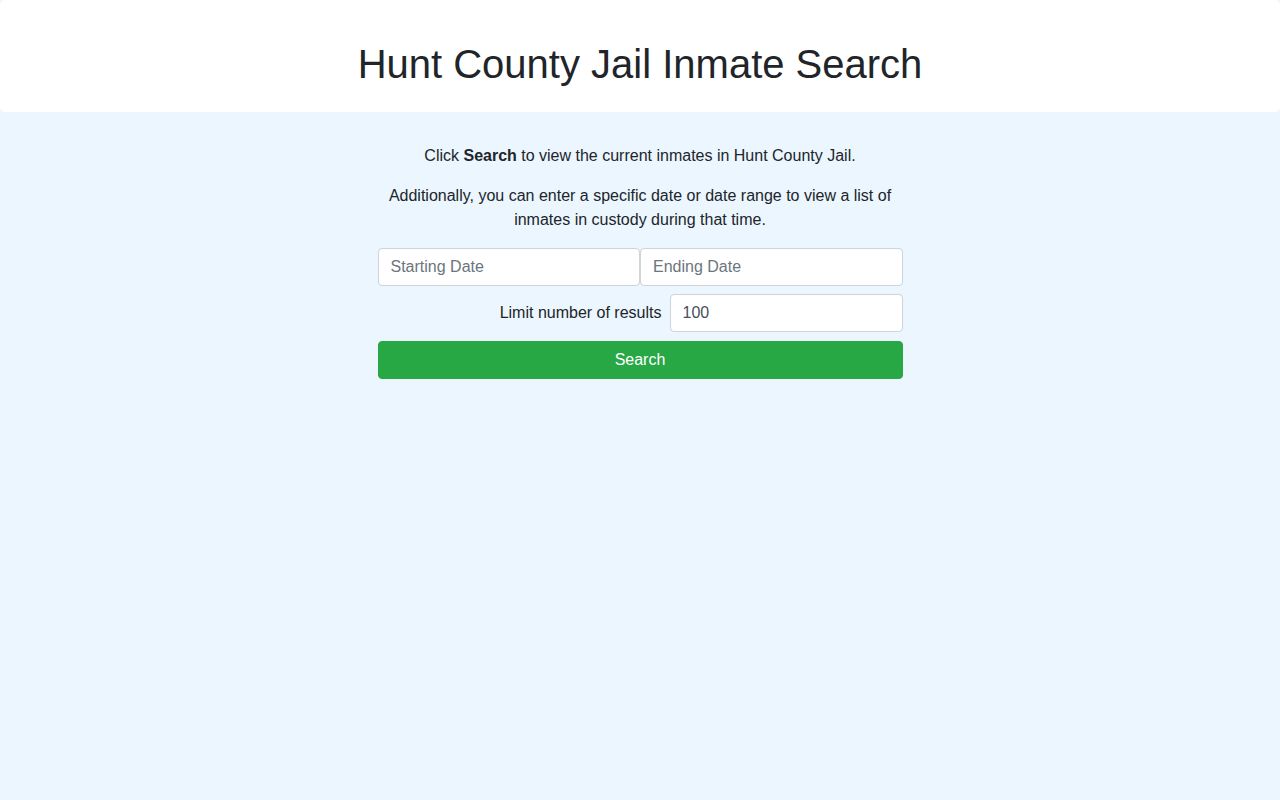
Those inputs define custody overlap. The Released Date column on the submitted results, not the three-day entry alone, identifies a possible release within the window.
Note: Record the exact three dates and Greenville time context before searching, especially when the period crosses a weekend, holiday, or midnight boundary.