
Hunt County Mugshot Record Limits
A mugshot is the identification photograph made during booking or institutional intake. It remains tied to that custody episode after release. In Texas, photographs can fall within public information under Government Code Chapter 552, but no rule makes every photo public in every posture. Active-investigation, juvenile, victim, medical, privacy, expunction, nondisclosure, and other laws may limit access.
Section 552.108 can protect law-enforcement material. Section 552.108(c) preserves basic arrest information, yet that provision does not automatically disclose each image. Open Records Decision 616 required a conviction-related mugshot outside an active investigation on its facts. It supplies context, not a blanket promise for all Hunt County booking photos.
Release and photograph publication also prove different things. The Hunt archive’s Released Date supports the end of a county booking. A photo supports identity at booking. Neither proves guilt, the final disposition, or where the person is now.
Presumption of innocence remains essential when the case did not result in a conviction. Even after a conviction, the image still depicts a past intake rather than present conduct. Preserve the booking date and originating agency whenever an image is saved or cited. Without that context, two arrests involving the same name can easily be merged.
Hunt County Release Photo Channels
Each image source covers a different population. The county archive is useful for locating the booking identifiers but not the released photo. TDCJ applies only after state-prison admission. The DPS registry is restricted to people with a registration duty. News and commercial archives are selective or nonofficial.
| Channel | Has photo? | How to access |
|---|---|---|
| Hunt historical jail archive | No released-row photo | Use it to obtain name, booking date, Released Date, and Jailing ID for a request. |
| Sheriff records request | Potentially, subject to law | Ask for the exact booking photograph through the Criminal Investigations records channel. |
| Official sheriff app | None verified | Do not treat staff mobile software mentioned in procurement as a public app. |
| TDCJ record | Potentially for state prisoners | Use a formal TDCJ public-information request; the free email route excludes photos. |
| DPS registry | Yes, for covered registrants | Use only as a narrow official registry channel, not a general release-photo search. |
| News or sheriff release | Sometimes | Match the publication date, attribution, identity, and case language to official records. |
| Commercial booking archive | Sometimes | Treat only as a discovery lead; it may be stale, wrong, or missing case disposition. |
Texas IVSS-Counties and TDCJ IVSS are notification tools rather than dependable photo archives. BOP and ICE locators answer custody questions. USMS generally does not release prisoner photos to the public. Using a channel beyond its stated scope creates false matches.
Hunt County Archive Hides Photos
The Hunt County jail archive accepts dates and returns Name, Gender, Race, Booking Date, and Released Date. Its markup also carries a Jailing ID. No booking image appears in the result list. When a released row is opened, richer booking detail is suppressed and the county may state that the selected party is not currently in jail.
No official consumer sheriff mobile app was verified. A procurement reference to a law-enforcement mobile license concerns staff software and cannot be recast as a public inmate-photo product. The official Hunt County 24-Hour Release List method likewise uses the archive’s release field and does not add a photo gallery.
This means the archive serves as an identification step. Record the exact displayed name, Booking Date, Released Date, and Jailing ID. Those details reduce the risk of requesting another person’s image or a photo from a different arrest.
Request Hunt County Booking Photos
The strongest official route is a targeted request through Hunt County Criminal Investigations. The office accepts requests in person or by fax to Claudia Alvarado at 903-461-7793 during its published weekday hours. Use the current county request form and describe an existing image rather than asking staff to identify someone from a narrative.
- Find the county archive row and copy the exact name, aliases if known, Jailing ID, Booking Date, and release range.
- Complete the current Hunt County open-records form.
- Ask for the booking photograph from that specific jailing episode. List the booking sheet separately if it is also needed.
- Request electronic delivery and a cost estimate before charges above a chosen amount.
- Keep the response, any withholding explanation, and the archive row together as source history.
Hunt County publishes no specific booking-photo fee or archive-retention term. Do not apply clerk copy fees to a sheriff request. Reports themselves cannot be faxed under the published policy, even though the office accepts the request by fax.
The county’s records-request page is shown below as the correct official photo fallback.
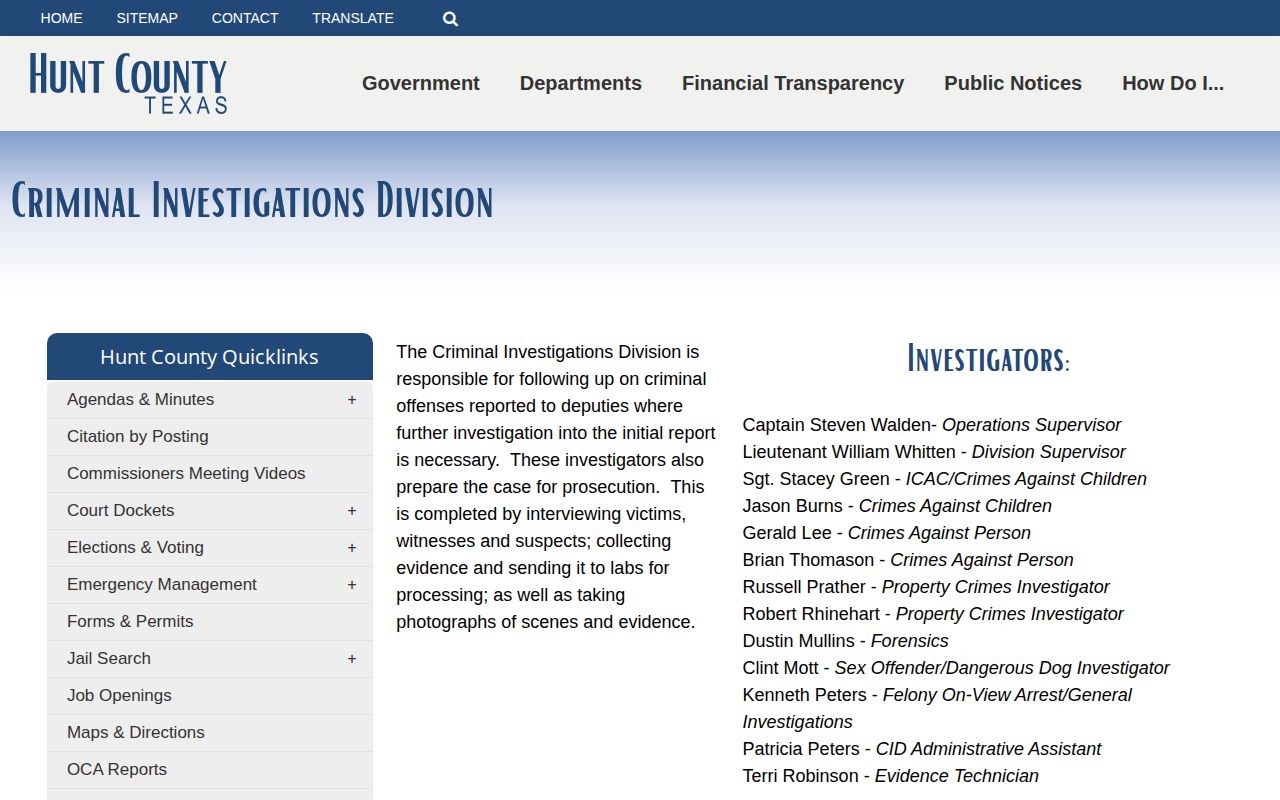
The page connects the request to the sheriff’s records process, where lawful exemptions and redactions can be addressed by the custodian.
Verify Hunt County Photo Sources
Hunt-specific commercial booking pages may retain images after the official released-row detail vanishes. They are nonofficial discovery leads. Their charge labels, physical descriptors, bond details, and claimed status can be stale or wrong. No commercial mugshot site should replace the county release record or signed case disposition, and none is linked here.
Local news or an official sheriff social post may preserve a photo tied to one event. Capture the original publication date, author or agency attribution, and exact allegation or disposition wording. Coverage is selective, so silence proves nothing. An arrest report must not be rewritten as a conviction. An image used in an arrest story also does not prove the person was later released.
Cross-check identity through the Hunt archive and court record. If two sources disagree, give priority to the custodian closest to the fact: Hunt County for its booking and release entry, the signed court order for disposition, and TDCJ Classification and Records for a state institutional image or discharge.
Source dates matter because live pages change. Keep the image’s original caption, publication date, and access date. If a later official correction appears, preserve both the earlier claim and the correction rather than silently blending them. News silence or a missing social post does not show that no photo exists.
Correct Hunt County Mugshot Records
For an error in an official Hunt County record, identify the exact booking row and the conflicting official document. Contact the records custodian and keep the written response. For a TDCJ image or release error, use Classification and Records or a formal TDCJ public-information request. The free TDCJ offender-information email route expressly does not provide photographs.
Texas Business & Commerce Code Chapter 109 regulates certain businesses that publish criminal-record information obtained through official channels. It addresses accuracy, correction, and some removal or correction fee practices, with stated exclusions. It is not a universal promise that every website must remove every image without cost.
Expunction under Texas Code of Criminal Procedure Chapter 55A depends on the arrest, disposition, and statutory conditions. Release alone does not create eligibility. A final expunction restricts later maintenance and dissemination under the statute. Nondisclosure under Government Code Chapter 411 limits public disclosure but is not record destruction. Copies made before an order may require separate correction steps.
A correction request should state the exact wrong field or image and attach the official order or record that conflicts with it. Ask the publisher or custodian to confirm what action was taken. Avoid broad demands that fail to identify the episode. For a lawful withholding or redaction, seek the stated basis rather than assuming that an absent photo was deleted.
Hunt County State-Prison Photos
A Hunt County arrest photo and a TDCJ institutional photo are separate records. TDCJ is relevant only if the person entered the Texas state-prison system. Someone released on bond, after a dismissal, or after county time without state admission may never have a TDCJ image.
Use the TDCJ offender search to confirm the correct institutional identity and number, but request a potentially releasable photo through the TDCJ public-information channel. TDCJ accepts requests through its published email, mail, hand-delivery, and online methods. Photos remain subject to exemptions and redaction.
The DPS sex-offender registry can display a color photograph for a person with a Chapter 62 registration duty. It is not a general post-release catalog. Presence may persist for years after discharge, and absence does not disprove release. USMS policy is more restrictive and generally does not make prisoner photographs public.
DPS also describes formal discharge proof used for an Ending Registration Date, such as a court discharge order, penal-institution release certificate, or an agency-letterhead statement from the supervising or discharging office. Those documents can be stronger evidence of discharge than a photo or commercial status label, but they apply only when the person has a registration duty.
- Booking photo
- An image tied to a specific arrest and county booking episode.
- Institutional photo
- An image held by a prison system after admission to that system.
- Expunction
- A court-ordered process with broad statutory effects when eligibility requirements are met.
- Nondisclosure
- A restriction on public disclosure that does not destroy every record.
Note: Match the photo source to the custody system; a TDCJ image cannot establish the details of a Hunt County-only release.