
Hunt County Release List Limits
There is no dedicated Hunt County 24-hour release feed. The official Hunt County jail search has a blank-search mode for current inmates and a dated mode for historical custody. Entering one day does not ask, “Who was released on this day?” It asks who was in custody at some point during that date range. Results can therefore include a person still held, a person released during the target day, and a person whose release came later.
The Released Date column is the key. A populated value shows that the listed Hunt County booking episode ended. Opening a released row can produce the official message that the selected party is not currently in jail. Together, those two details are useful release evidence. They do not show the exact release time, release reason, destination, or court authority. Hunt County also publishes no update schedule or archive-retention promise, so a fresh entry may lag and an old absence has several possible causes.
Check Hunt County Releases Today
Use calendar dates that cover the desired same-day period in Greenville. Keep a note of the dates entered because the results page is produced by a form submission and its bare address does not preserve the query. A short range reduces noise, but it still finds custody overlap rather than releases alone. Match more than a name whenever possible.
- Open the official Hunt County jail search and enter the starting and ending dates for the target day.
- Choose a practical result limit. The form displays a default of 100 and a maximum of 500.
- Submit the form, then match the full displayed name and Booking Date. Use the Jailing ID when it is available in the record markup.
- Read Released Date for every possible match. Do not count a row merely because it appeared in the dated search.
- Open a released row and retain the no-longer-in-jail response, then compare the court or receiving-agency record if destination matters.
A long-stay inmate can match each day of a confinement period. Total Rows is thus not a daily release count. The broader Hunt County 72-Hour Release List process can catch a date estimate that was off by a day or two, while the home page is the better route for a named-person search across county, state, federal, and immigration systems.
Hunt County Release Fields
The archive exposes a narrow set of fields. It is enough to identify a likely booking and determine whether Hunt County marks that episode as ended, but it is not a full release sheet. The following inventory describes what is actually present rather than what a generic jail feed might show.
| Field | What it shows |
|---|---|
| Name | The displayed identity for the booking row. Confirm with another identifier when names are similar. |
| Gender and Race | Basic descriptors used to separate possible matches, subject to source accuracy. |
| Booking Date | The start date tied to that Hunt County jailing episode. |
| Released Date | The date Hunt County records the booking as ended. A blank field is not a confirmed release. |
| Jailing ID | An identifier carried in the result markup that can help target a records request. |
The public table does not supply release time, release type, destination, receiving agency, authority, or a released booking photo. Ask for those existing fields through the sheriff’s record channel if they are needed and public. Never infer a bond, dismissal, sentence completion, or transfer solely from Released Date.
Hunt County Archive Release Quirk
Hunt County’s archive has an unusual tradeoff. It preserves historical date searching and displays Released Date, which is more useful for past custody than a live roster alone. Yet opening a released row suppresses the richer booking details. The result may only state that the selected party is not currently in jail. This is the Section 19 archive angle that makes a two-record check necessary.
First, preserve the archive row for the actual end date. Second, obtain the court order or requested jail record for the legal reason, exact time, and destination if recorded. A court order signed that day may explain authority, but it may precede physical processing. Likewise, a later TDCJ, BOP, or ICE entry may show where custody continued. Each record answers a distinct question.
Search failure also needs care. A different spelling, alias, wrong date range, another holding facility, a lawful restriction, a technical issue, or unpublished retention may explain it. Broaden known dates before treating absence as meaningful.
Hunt County Release or Transfer
“Released” means the Hunt County booking ended. It does not always mean the person entered the community. Bond can end jail custody while a case and conditions remain active. Time served differs from dismissal. A transfer to TDCJ, another jail, the U.S. Marshals Service, or ICE ends Hunt custody while another agency takes control.
| Archive sign | Meaning | Next check |
|---|---|---|
| Blank search, current row | The live view treats the person as in Hunt custody. | Call the jail for an urgent status check. |
| Filled Released Date | That county booking episode ended. | Open the row and check the case record. |
| Later TDCJ entry | State custody may have followed county custody. | Use the TDCJ offender detail or records office. |
| Federal or ICE record | Another sovereign system may have received the person. | Use BOP or ICE within each locator’s limits. |
Texas IVSS-Counties can provide custody or court notifications for available participating records, but an alert is secondary. Texas replaced the former county VINELink system in 2025. TDCJ IVSS is separate and covers state prison and parole events. A transfer alert is not community release.
Hunt County Bond Release Today
Hunt County’s Bail Bond Board publishes an official board page and a licensed-company list. These sources help identify the regulated local bond channel, but no fixed countywide bond schedule was verified. The amount and conditions belong to the person’s magistration or court record.
A bond release ends jail custody while the criminal case stays open. Hunt County’s bond-condition order can require immediate reporting to HCCSCD Pretrial Supervision. That means the useful same-day sequence is the archive’s Released Date, the signed bond or condition order, and the released person’s own HCCSCD instructions. Do not call bond-out a dismissal or completed sentence.
- Bond release
- Departure from jail while the charge remains pending under set conditions.
- Time served
- A judgment credits enough confinement to satisfy that part of a sentence.
- Transfer
- One agency ends custody because another agency receives the person.
Travel After Hunt County Release
No official source gives a fixed Hunt County release hour, exit door, family waiting point, or ride program. The detention visitation schedule does not establish release processing times. Families should confirm plans with the Hunt County Detention Center rather than assume a daytime exit or a set pickup location.
The Connection is the only verified countywide transit angle in the research. It is a general, reservation-based public service, not a jail release shuttle. Its published weekday and advance-reservation model may help when pickup can be planned, and it advertises some same-day availability. It may not solve an unplanned night or weekend discharge. Availability and fare should be confirmed directly at 903-454-1444.
The service lists 4912 Lee Street in Greenville. That address is not a jail pickup point. A traveler must arrange the actual trip with the operator and confirm where boarding is possible.
Verify Hunt County Same-Day Release
When the archive is unclear, call the Hunt County Detention Center at 903-453-6851 about the specific booking. For a fuller existing record, use the Sheriff’s Criminal Investigations and open-records route. Requests are accepted in person or by fax during published weekday hours. Identify the full name, aliases, date of birth if known, Jailing ID, booking date, and target release range.
Ask separately for the booking sheet, release log entry with actual date and time, release reason or type, destination or receiving agency if recorded and public, authority or order, and booking photograph if needed. Hunt County publishes no specific release-record fee or retention term. Request electronic copies and a cost estimate instead of borrowing the court clerk’s copy fees.
Use the court portal and proper clerk for legal disposition. Use TDCJ only when state admission is plausible. BOP covers federal imprisonment, while ICE ODLS has a limited current and recent-custody scope. No one system covers all Hunt County release outcomes.
Texas Public Information Act timing also deserves precision. The ten-business-day provision generally concerns an agency seeking an Attorney General decision when withholding. It is not a guaranteed delivery date. Section 552.221 calls for prompt production, subject to volume, review, and lawful limits.
For a visual reference, the official Hunt County archive form shows the date-range fields used for this same-day check.
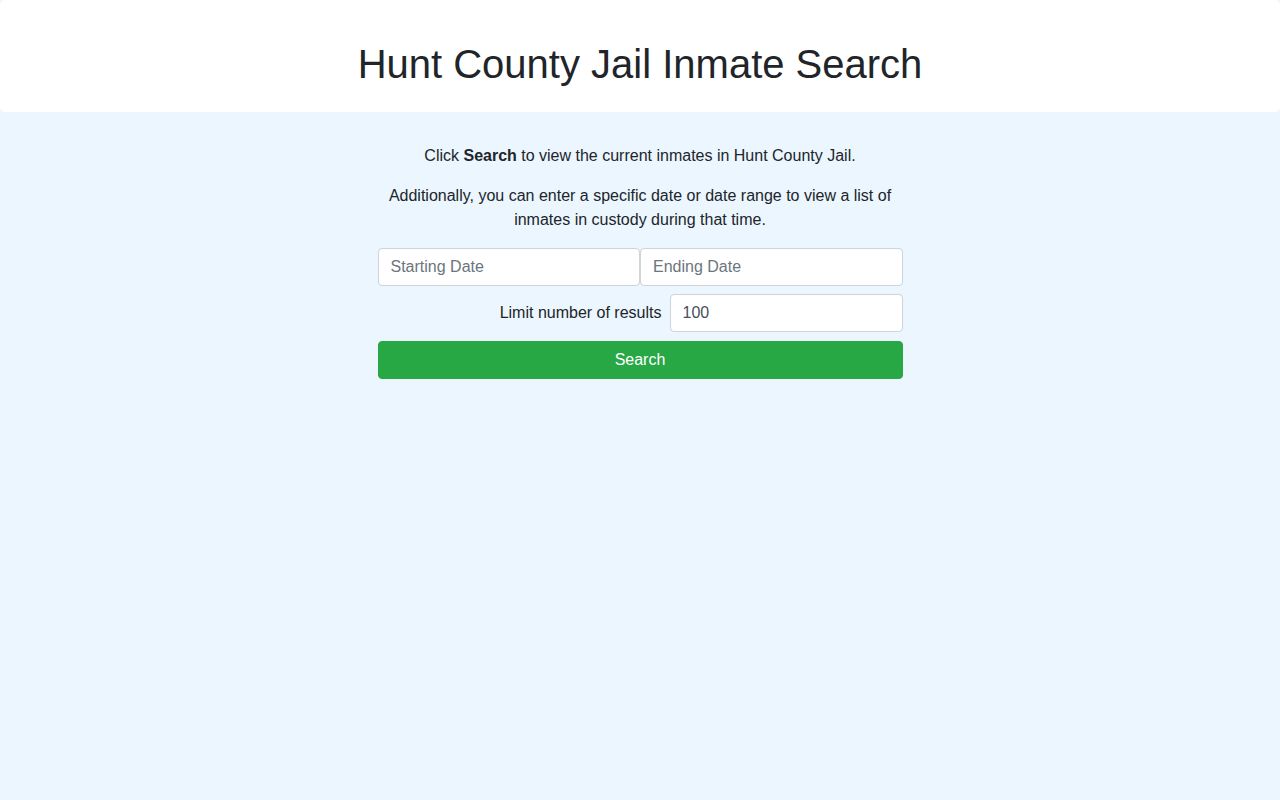
The form confirms that the county supplies custody dates and a result limit, not a labeled release-only feed.
Note: Keep the submitted dates, Released Date, and source-access date together so later checks can be reconciled without changing the record’s meaning.